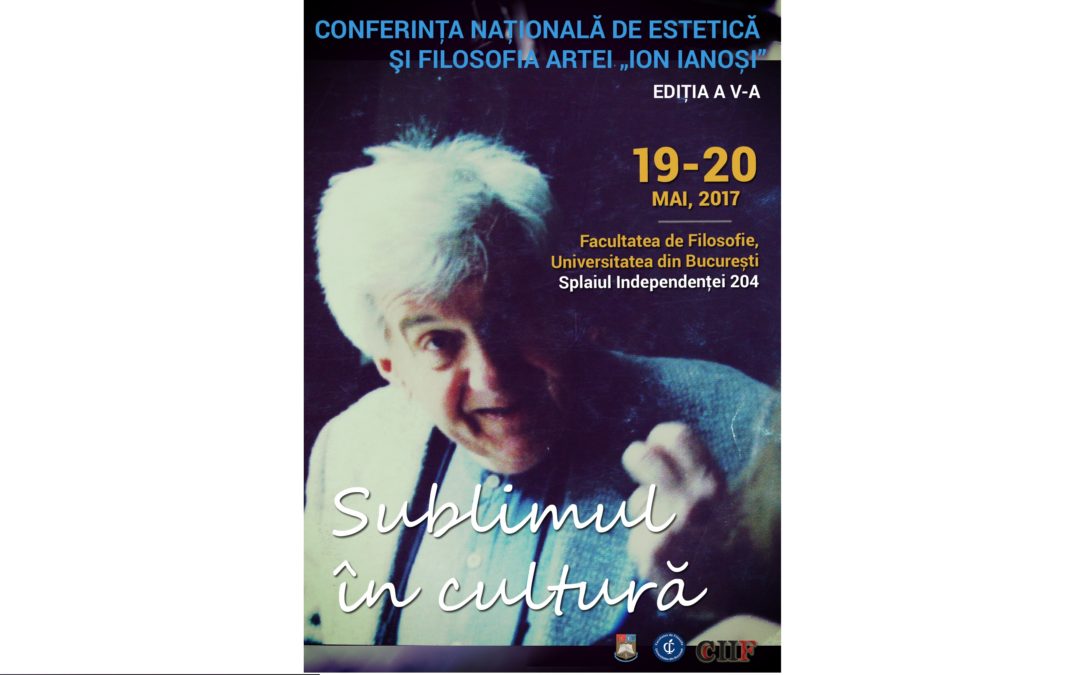
The Faculty of Philosophy of the University of Bucharest, through the Centre for Research in the History of Philosophical Ideas, is organising, on 19-20 May 2017, the fifth edition of the „Ion Ianoși” National Conference on Aesthetics and Philosophy of Art. This year's edition is dedicated to the personality of Professor Ion Ianoși, a writer and essayist of Jewish origin from Romania, professor of philosophy and aesthetics, theoretician, monographer, translator, specialist in Russian philosophy and literature, and honorary member of the Romanian Academy. The conference will take place at the headquarters of the Faculty of Philosophy (str. Splaiul Independenței, nr. 204).
The organisers of the event are Prof. Mihaela Pop, PhD, a member of the teaching staff of the Faculty of Philosophy, and Oana Şerban, doctoral student in philosophy at the University of Bucharest.
The scientific event will bring together university professors, researchers, academicians, doctoral students and students who will deliver papers on the sublime in culture in the plenary session, held on Friday, 18 May 2017, and in the student session, which will take place on Saturday, 20 May 2017.
The conference proposes a dialogue on the theme of the sublime, addressed by Professor Ianoși in many of his works. This theme is still topical today, not only in artistic manifestations, but also in aesthetic thought. The sublime is the notion capable of accounting for the complexity of aesthetic, ethical and philosophical states. Professor Ianoși considered the sublime to be „the most ethical of man's aesthetic qualities” (Estetica, 1975, p. 127) and noted a nuanced correlation between the aesthetic and the religious within the sublime.
To what extent can the heightened associative taste of our century benefit from the sublime's openings towards various directions of cultural research? Can the Kantian meanings of the sublime still offer answers today to the moral and aesthetic problems of contemporary society? What are the reasons why the sublime, as an aesthetic modality, is knowledge and understanding of life and of the major ethical imperatives? These are a few of the possible questions to which answers are expected, starting from the numerous works, full of generous ideas, of Professor Ion Ianoși.
The entire programme of the conference organised by the Faculty of Philosophy can be consulted here.