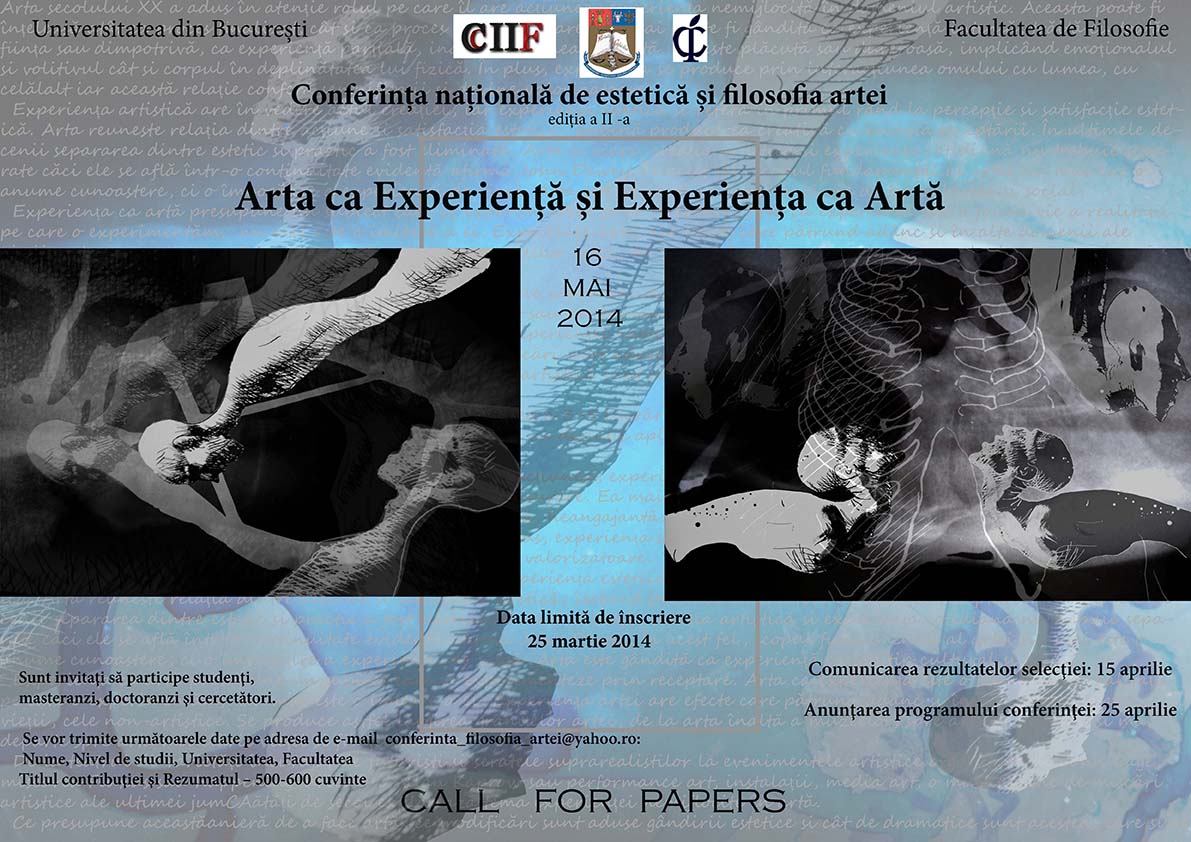
ART AS EXPERIENCE AND EXPERIENCE AS ART
The art of the twentieth century brought to the fore the role played by action, by immediate experience in the artistic field. It can be understood both as a completed process and as a process in progress. It can also be thought of as an intense experience, lived with one's whole being, or, on the contrary, as a partial, indifferent, non-committal experience. It is pleasant or painful, involving the emotional and the volitional as well as the body in its full physicality. Furthermore, experience occurs through the human being's interaction with the world and with the other, and this relation confers meanings and becomes value-conferring.
Artistic experience takes into account the act of creation, while aesthetic experience refers first of all to perception and aesthetic satisfaction. Art unites the relation between action and aesthetic satisfaction, it combines creative production with the energy of reception. In recent decades the separation between the aesthetic and the practical has been eliminated. Art and life, artistic creation and everyday experience must not be separated, for they stand in an evident continuity, affirms John Dewey. In this way, the fundamental aim of art is no longer a certain knowledge, but an enrichment of the experience of life. Art is thought of as a living experience of a cultural and social kind.
Experience as art presupposes a subject who experiments through reception. Art as experience is a living form of the reality we experience, it is no longer an imitation of it. The experience of art has effects that penetrate deeply into other domains of life as well, the non-artistic ones. Thus there occurs a widening of the boundaries of art, from the high art of museums towards consumer art and further towards the art of modelling life and the human being.
From the variety theatre encouraged by the Futurists and the soirées of the Surrealists to the artistic events organised by John Cage, the Fluxus movement or Allan Kaprow's happenings or performance art, installations, media art, a multitude of artistic movements of the last half-century explore the theme of immediate experience in art.
What does this manner of making art presuppose, what changes are brought to aesthetic thinking and how dramatic are they, what are the consequences for the notions of aesthetics and artistic creation — these are a few questions to which we invite you to find answers together.
Send an abstract of 500-600 words, mentioning 3-5 reference works, by 25 March to the address conferinta_filosofia_artei@yahoo.ro
The conference will combine moments of theoretical presentation with applied discussions within round tables, to which short performative moments and art exhibitions will be added.
Organising Team:
Assoc. Prof. Dr. Mihaela Pop
Assist. Dr. Raluca Oancea
MA student Oana Serban
MA student Alfred Schupler
MA student Dana Bobocel
PhD candidate Isabella Draghici
PhD candidate Maria Buleu