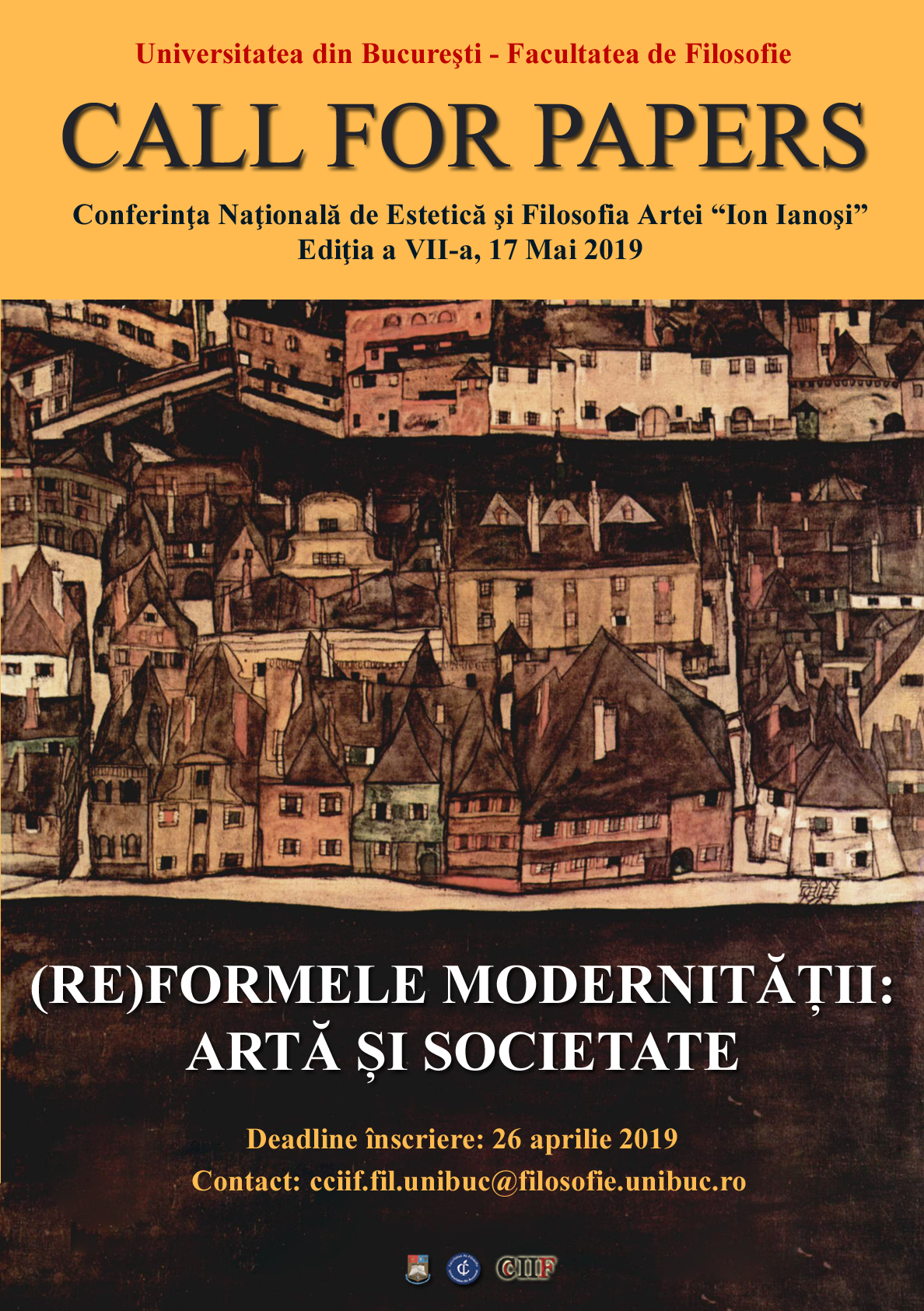
Call for Papers
NATIONAL CONFERENCE OF AESTHETICS AND PHILOSOPHY OF ART „ION IANOȘI”
SEVENTH EDITION
(RE)FORMS OF MODERNITY: ART AND SOCIETY
Throughout history, art has constituted the territory for representing both the real and the ideal dimensions of life. If the horizon of classical art, predominantly associated with mimetic representation, is dominated by themes such as the relation between the individual and divinity, between the human being as part of society and the community as a rational organization of citizens, working through various metaphysical or theological hypotheses, modern art will resort to the means of transgression in order to capture the forms through which artistic representation can contribute to the reform of society. Artistic modernity, specific to the 19th century, becomes the epochal interval in which „life imitates art”, assumed as a source of inspiration for everyday life, for the new social and axiological order.
For Oscar Wilde, the metropolitan landscapes of London began to appear in the paintings and literary works of modern art in a new play of shadows, architectures and emotions that indicate that „even the way we look at the fog has changed because of art”, that „all these things seemed not to exist until art invented them”. The artist insinuates himself, in this context, as a „man of the world” and as an eternal „child” of his society, after Baudelaire's observations, as an attentive observer of immediate reality, conquered by the unrest of war and marked by the antagonism of social classes. The culture of modernity will germinate, starting from here, the revolutionary agenda, on the social plane, of the artistic movements subsumed under the avant-gardes. Art's complicity with the evolution of capitalist culture; the emergence of mass culture and the triumph of kitsch as an expression of mechanized, industrial, serial culture; the theorization of the differences between high culture and low culture through the lens of the corresponding art objects trace, symptomatically, the tendencies of assuming the social mission that art has to fulfil in modernity.
How much of the lifestyle of the modern individual has been folded onto the demands of the industrial culture raised on the ruins of the „Enlightenment” failure (Adorno, Horkheimer)? How much of the new art forms emerging in the „age of mechanical reproduction” (Benjamin) satisfy the requirements of „authentic art”? How much of the features of the „society of the spectacle” (Debord) point to the manifestations of a decadent culture? These are questions that synthesize, in fact, multiple answers to a philosophical interrogation guiding the reflective endeavour initiated by the present conference: what is the relation between art and society in modernity? In other words, to what extent does art offer the modern individual the necessary instruments to reform society radically, in the direction of both standards of living and moral and aesthetic values, or in the sense of opening, founding and propagating criticism of ways of life and of normalizing certain social conducts or practices? The manner in which modern art created ruptures between different stages of modernity broadly understood made it possible to distinguish the utopias and dystopias of modernity, or whether it rallied society's reformers as revolutionaries, responsible agents, committed critics or „authors” of cultural products indicates to us the possibility of thinking the social world starting from the worlds of art.
The challenge of the seventh edition of the National Conference of Aesthetics and Philosophy of Art „Ion Ianoși” is that of investigating the modern particularities of the relation between art and society starting from the themes and directions suggested above. We invite you to answer our call using interdisciplinary resources in order to explain to what extent art generates, supports, dethrones and reforms the different faces of modern society: the open / closed society (Bergson; Popper), class society (from Marx's observations to the neo-Marxist legacy), bureaucratic society (Baudrillard), knowledge-based society (Habermas), one-dimensional society (Marcuse), collaborative, relational society (Bourriaud), consumer society (in Warhol's or Lipovetsky's sense).
The conference is organized by CCIIF – the Centre for Research in the History of Philosophical Ideas, within the Faculty of Philosophy of the University of Bucharest. By tradition, partners in this endeavour are the National University of Arts in Bucharest and the University of Music in Bucharest.
Submission deadline
Abstracts, of no more than 500–600 words, stating the topic and the bibliography of the proposed presentation, accompanied by 5–6 keywords, should be sent to the email address cciif.fil.unibuc@filosofie.unibuc.ro
Within the proposals, the participant's CV should be attached, focused on the works of relevant activities from the last 3 years, also mentioning academic affiliation (in the case of master's students, doctoral students and researchers). Participating students will send, with a view to registration, attached to the abstract, a presentation of the activities carried out since the beginning of their academic path.
Deadline: April 26, 2019.
Announcement of results
Following the selection made by a specialized commission (composed of academic staff from the Faculty of Philosophy), the results will be announced on May 4, 2019.
The conference will take place on May 17 at the Faculty of Philosophy of the University of Bucharest.
Organizing team
- Prof. Dr. Mihaela Pop
- Assist. Prof. Dr. Oana Șerban
- Dr. Rodica Ivan-Hainz
Scientific committee of the conference
- Prof. Dr. Viorel Cernica
- Prof. Dr. Vasile Morar
- Assoc. Prof. Dr. Cristian Iftode
- Lect. Dr. Cornel Florin Moraru
- Lect. Dr. Raluca Nestor Oancea